- Parking available
- Bus stop available
- Free admission
Bredelar
Various Attractions
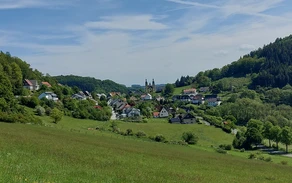
Bredelar is defined by the Cistercian monastery, which was founded in 1170 by Archbishop Philipp von Heinsberg—a monastery for women of the Augustinian Order, the Premonstratensian Sisters; which served as a Cistercian abbey from 1196 to 1803.
In addition to the Protestant Christuskirche and the Catholic Christkönig Church, there is also the Bredelar Monastery Cultural and Community Center, which houses the Kunstraum Sauerland exhibition hall and the local history collection.
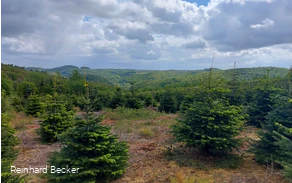
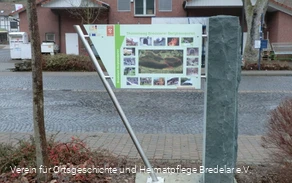
Extensive mixed forests invite visitors to take long hikes along the Bredelar Mining Trails, for example. Here, you’ll also pass a noteworthy Mariengrotte in the forest.


Properties:
The name of the town suggests that it was settled as early as the very early Middle Ages. In Old High German, lar means “pasture,” so Bredelar means “extensive pasture.” The history of Bredelar is closely linked to the history of the Premonstratensian convent—and later the Cistercian monastery—located in the municipality.
The first recorded mention of the town dates back to 1170. In that year, Philip of Heinsberg, Archbishop of Cologne, endowed an existing church in Breidelare—dedicated to St. Lawrence—with a convent for women of the Augustinian Order, the Premonstratensian Sisters. He had received the site for this new monastic settlement—an estate and a mill in the Hoppecke Valley—from his vassal, the castellan Codescalus de Padberg, Gottschalk von Padberg, in exchange for his own properties in Beringhausen, Oesdorf, and Borntosten. The leadership of the convent was entrusted to an abbess. Spiritual oversight was entrusted to the Premonstratensian monastery in Scheda. The lord of the castle, Gottschalk von Padberg, retained the bailiwick over the monastery. The less-than-pious lifestyle of the nuns led to this first foundation being short-lived.
In 1196, Archbishop Adolf of Cologne (1193–1205), at the request of Gottschalk von Padberg—a son of the lord of the castle mentioned in 1170—decided to convert the convent into a Cistercian monastery. The nuns were transferred to Rumbeck, and the monastery’s ties to Scheda were severed. For their part, the lords of Padberg relinquished their bailiwick, which was contrary to the Cistercian Rule. The monastery was staffed with monks from Hardehausen. In 1201, Bishop Bernhard II von Oesede of Paderborn consecrated the churchyard in Bredelar and confirmed the monastery’s ownership of the property. In the 13th century, the monastery made a concerted effort to systematically expand its holdings, particularly in the neighboring villages. Thus, the monastery—mostly through purchase—became the almost sole landlord of the settlements of Giershagen, Beringhausen, Messinghausen, and Bontkirchen, which were virtually designated as “Bredelar monastery villages.”
Between 1470 and 1518, the monastery sold its properties on the Sintfeld to the Dalheim Monastery. The Thirty Years’ War brought great hardship to the town and the monastery, leading the monks to leave the monastery in 1631. However, before the end of the war, the monastery was renovated and restored.
During the Seven Years’ War, the monastery was also drawn into the fighting in 1761 and sustained damage during an assault. In 1784, the entire monastery complex, including the church, burned down. With the exception of the south wing—which was destroyed by fire in 1884—the surviving buildings date primarily from the period of reconstruction following the fire. In 1803, the monastery was dissolved and, as part of the secularization process, passed to the Landgrave of Hessen-Darmstadt. The extensive lands became state-owned estates, and the abbey buildings were converted into an iron foundry in 1842 or, in part, used for agricultural purposes.
In 1900, the town—which until then had formed a single municipality with Giershagen—became a politically independent municipality. The administrative association was dissolved because the two towns had developed in completely opposite economic directions.
Directions
Bus routes from Marsberg Train Station: 385 and 391 Direct train connection to the Dortmund-Sauerland Express Marsberg Train Station is centrally located in the city center. In addition, there are approximately 1,000 free parking spaces within a 500-meter radius of the Marsberg city center, including the Park & Ride lot on the street “An den Gleisen.” You can get to Marsberg… …by car: • A44 Dortmund–Kassel (Marsberg interchange, Lichtenau interchange) • B7 Chemnitz–Düsseldorf (direct connection) • A33 Paderborn–Osnabrück (about 30 minutes) • B252 Blomberg–Marburg (about 20 minutes) • A7 Kassel–Hanover (about 60 minutes) … by train (hourly service): • Dortmund-Sauerland-Express (Warburg–Dortmund) • Three stops in Marsberg: Bredelar, (Nieder-)Marsberg, Westheim • Direct connection to the IC/ICE stations in Warburg and Dortmund