- Culturally interesting
- Place to stop for a bite to eat
- Circular Trail
- Currently closed
Through sunken castles and across wild cliffs
A beautiful, legendary, and historic trail through nature worthy of protection and the Krähenpfuhl and Albaumer Klippen nature reserves.


Tour starting point:
Albaum: Nieder-Albaum, parking lot by the church
Tour destination point:
Albaum: Nieder-Albaum, parking lot by the church
Properties:
Additional Information
The “Albaumer Cliffs, ” a rocky ridge approximately 750 m long that has been designated a nature reserve , are arguably the most impressive remnant of the Lower Devonian period, dating back some 480 million years. The massive rocks consist of quartz keratophyre, a reddish rock formed from volcanic magma that played a special role in the region’s building traditions for a long time. The cliffs did not take on their current appearance until the Ice Age. Frost action created boulder fields up to 50 m wide at the base of the cliffs , consisting partly of boulders weighing several metric tons and partly of head-sized rubble. The cliffs and boulder fields are home to a unique vegetation of mosses, ferns, and lichens, so they must not be walked on. This hiking trail leads right up to the protected area and offers glimpses into this unusual natural heritage.Entering the cliff formation is prohibited.
The Legend of the Schanollen
In Nieder- and Oberalbaum, a footpath takes you past the Albaumer Cliffs—some of which tower as high as thirty meters—fifteen massive porphyry rocks piercing through the greywacke.
Schanollen Hut; at the upper half of the cliffs, the Schanollen Spring emerges, and there lies the Schanollen Gate with the Schanollen Hut. The Schanollen Gate was once a stone semicircular arch, which is no longer visible today. The Schanollen House is a rock shelter large enough to accommodate one man.
There, and in their other hard-to-reach caves, lived the Schanollen—small dwarves and goblins. For a long time, they rendered many a service to the people of Albaum. It was not uncommon for the stables to be cleaned, the livestock tended to, and the cows milked without the farmer in question having to lift a finger.
The Schanollen frequently performed these and other tasks on the Hellermann family’s farm (Haus Mertens), since this farm was the closest to the Schanollen’s home. From there, they would make their way through Kleff and Kellerberg to Oberalbaum. As helpful as the Schanollen could be, they would not allow anyone to intrude upon their mysterious realm on the cliffs.
But one day, a lovely, blossoming girl climbed up the Albaum cliffs. While picking flowers, she soon lost track of the path and walked deeper and deeper into the realm of the Schanollen. The girl has never been seen since, and the Schanollen have also vanished. Massive boulders had tumbled down at the spot where the girl had last been seen. A dense tangle of rocks blocks the Hollen’s caves, and more than a few tasks had to be left undone on a hard day because the Schanollen refused to help.
Only sometimes can one see a white figure walking on the cliffs, wringing her hands in desperation and quietly lamenting and weeping.
(Based on traditional stories from the Sauerland)
The Legend of the Krähenpfuhl
In ancient times, a castle is said to have stood near the Krähenpfuhl, inhabited by a godless, savage knight. Through his hunters, he had women and girls abducted and dragged to his castle. One of these girls, Christine Rohen from Albaum, put up insurmountable resistance against him. But he wanted to force her to submit, just as one tames a fox or a falcon. Day and night, the girl’s tears and pleas for protection and help rose to the heavens. The Christian missionary who had baptized Christine boldly made his way up to the castle and confronted the knight with his wicked deeds. But the knight merely laughed at the man of God’s warnings and threats and had him chased out of the castle by dogs. Late that same evening, the Stüvelhagen shook to its very foundations. A rumbling storm rose rapidly, causing the earth to sway under its powerful blows. Blinding flashes of lightning licked around the castle, lapping at its doors and gates and melting the bolts. With her hair flying, Christine fled from the dungeon and leaped into the wide moat surrounding the castle. The burning castle swayed and sank into the floodwaters, which swallowed up man and mouse alike. The next morning, waves surged where the castle had once stood, and the body of the abducted girl floated on the water. When her horrified parents, who had rushed to the scene, pulled their child out and laid her on the lawn, she opened her eyes and said, “Don’t cry, Mother, the knight didn’t hurt me!” Then she breathed her angelic soul’s last. Christina’s body was buried in Kirchhundem, where it was later found intact during the construction of the old church.
It is believed that the legend reflects the memory of a bloody crime committed against a young woman here at Krähenpfuhl in times long past. Over the course of generations, the story may have been embellished to the point where a caravanserai—which may once have stood here—became a castle, and the murderer became a robber knight.
(Source: Josef Rinscheid. History of the Kohlhagen Parish. Olpe 1933. Johannes Neuhaus-Dobbener: Traditions from the Flape and Albäumertal Valleys, esp. regarding the legend of the Krähenpfuhl. Heimatstimmen from the Olpe District, Issue 11, 1953. p. 704ff.)
The Krähenpfuhl Nature Reserveis a biotope complex comprising two sub-areas of juniper heath, swamp forests, and spring bogs on a waterlogged saddle at Katzenstein, west of Nieder-Albaum. The northern subarea of the Krähenpfuhl Nature Reserve covers approximately 3 ha and consists primarily of a moist juniper heath with many well-grown junipers reaching heights of up to 4 m. These are sparsely interspersed with numerous individual trees, mostly pines and birches. Detailed information can be found here
“Richtplätzchen”
In the summer of 1985, archaeologists from the Office for Land and Cultural Heritage Preservation excavated this execution site. This is supported by the Heidtschötter hunting map from 1743 and by archaeological finds.
The proximity to the old Kriegerweg, the elevated position, and the sweeping view of the former execution site, as well as the proximity to Galgenberg and the “Vier Linden,” the Vasbach court of justice, leave no doubt that the unknown builders chose this elevated site to deter locals and, above all, travelers on the Kriegerweg.
There is also much to suggest that Trine Prinz from Oberalbaum was executed at this site on October 23, 1681
. The 21-year-old maid had killed her child after giving birth. After 33 days of detention and investigation, the lay judges’ court of the Bilstein district sentenced Trine Prinz to death by the sword. The sentence was carried out immediately by the executioner from Olpe. The death register of the St. Peter and Paul Parish in Kirchhundem lists the place of death as “Doitmecke,” the date of burial as October 23, 1681, and the cause of death as “…was beheaded for infanticide.” Today, the field name where we are standing is “In der Deitmicke.”
Thematic trail “geschichtet & verwoben” – art project on the Kleffweg in Albaum – a worthwhile stroll along the Kleffweg in Albaum (starting at the church); Information here
:
Pilgrimage Trail “Alter Kirchweg – Rediscovered”: A section of this pilgrimage trail runs parallel to the circular route; information can be found here.
Category
ThemenwegLength
14.6 kmDuration
4:30 hElevation ascent
380 mElevation descent
380 mLowest point
363 mHighest point
578 mCondition
Difficulty
Recommended seasons
This varied and informative loop trail, which includes a delightful place to stop for refreshments, leads through rustling forests and nature reserves, along babbling streams and through places steeped in legend, past rugged cliff formations and the Kohlhagen pilgrimage church.
Information
Directions
Starting at the church in Nieder-Albaum, the hiking trail first follows the former Albaum–Kirchhundem church path (Way of the Cross) to the “Richtplätzchen” (signpost location). From the Richtplätzchen, the trail continues along the so-called Kriegerweg (marked with a “triangle” symbol) through the Krähenpfuhl nature reserve and past the “Versunkenen Schloss” (information signs) heading south until the trail meets the Rothaarsteig access trail (yellow markings with a horizontal “R”). At this trail junction, you’ll have the opportunity to stop for a break at the Landhotel / Café Gut Ahe (Tel.: 02723-3251; a short detour of about 600 m toward Wirme). The hike follows the Rothaarsteig access trail toward Heinsberg. After crossing the “Lütke Aa,” the tour follows the “white rectangle” trail marker northward to Ober-Albaum (2.2 km). From Ober-Albaum, the trail follows the trail markers toward Heinsberg for about 1.5 km until reaching the “Albaumer Klippen” (information sign). Now, first walk back about 400 m along the same trail to the signpost for “Albaumer Klippen Nord,” and from this intersection, the tour follows Trail A 2 via Böminghausen (1.4 km) back to the starting point in Nieder-Albaum (approx. 2.8 km) .
Equipment
Sturdy shoes and weatherproof clothing are recommended;
Safety guidelines
Information About Emergency Signs
Hiking trails usually run away from towns and settlements, and every hiker has wondered at some point what would happen if an emergency were to occur. How can I be found here? Where am I, anyway? Can emergency services reach me?
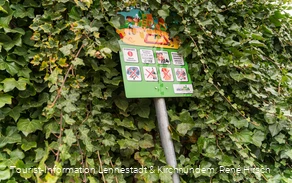
But in an emergency, time is of the essence! That’s why the hiking trail network in the Lennestadt & Kirchhundem region is equipped throughout with so-called rescue signs. The green-and-white plaques attached to the signposts feature a number that you must provide when making an emergency call. This allows emergency responders to know exactly where you are, saving valuable time.
Author Tip
Stop by the Albaum village store or drop in at the Gut Ahe farm café. It’s worth taking a look inside the Kohlhagen pilgrimage church, which is also a “Sauerland Place of the Soul”!
Maps
Hiking Map of Lennestadt & Kirchhundem, 1:25,000
Lennestadt & Kirchhundem Tourist Information
Hundemstr. 18, 57368 Lennestadt
www.lennestadt-kirchhundem.de
Lennestadt & Kirchhundem Tourist Information
Hundemstr. 18, 57368 Lennestadt
www.lennestadt-kirchhundem.de
Public transit
From the Lennestadt-Altenhundem train station, take bus line R93 to the "Nieder-Albaum" bus stop
How to get there
From the A4 or A 45 via the B55, B517, and L713 to Kirchhundem-Albaum
Parking
Parking lot at the church in Nieder-Albaum