The term “Old Testament” originally meant “Old Covenant” (Latin: testamentum), and refers to the people of Israel, who at that time consisted of twelve tribes. The parish of Hellefeld, for its part, originally consisted of twelve villages (Hellefeld, Herblinghausen, Frenkhausen, Visbeck, Altenhellefeld, Linnepe, Meinkenbracht, Weninghausen, Westenfeld, Bainghausen, Schnellenhaus, and Selschede) and is one of the oldest parishes in the Sauerland region; thus, this name alludes to the parish’s great age.
It is commonly said that Friedrich Wilhelm Grimme remarked in 1866 that a church had stood here even before the birth of Christ, and that this is why the name “Old Testament” came into use. This cannot be entirely dismissed, as it was common practice during the era of Christianization to build churches on the sites of ancient Germanic places of worship; thus, a sort of “gathering place” may well have existed there before a Christian church was constructed.
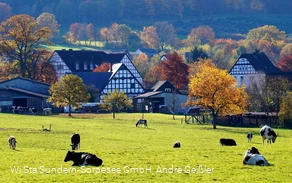
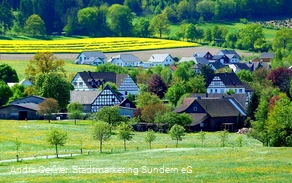
In the resort town of Altenhellefeld, situated in the heart of the “Old Testament” and first mentioned in 1236, you’ll find not only the well-preserved half-timbered houses in the town center but also an extraordinary natural landscape featuring Wacholderheide. Since there is no evidence of major village fires in Altenhellefeld dating back to the Middle Ages, and since the original land registry from 1829 still predominantly lists the farm names that were already recorded in 1484, it stands to reason that the village’s current structure has existed since the end of the Middle Ages.
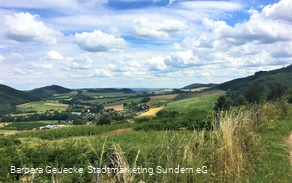
The “Altes Testament” hiking paradise offers beautiful trails with often breathtaking views.