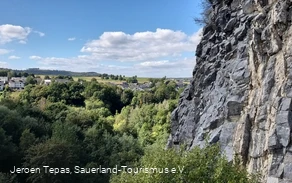
Large limestone deposits and their associated features are defining elements of the region around Warstein. Limestone was needed in agriculture; houses and walls were built from it; and its mining had a profound impact on social and economic life. Geological deposits spark the interest of geologists and mineralogists, while phenomena such as disappearing streams, caves, and fossils inspire a spirit of discovery in young people.
The Suttrop quartz, known as the “Suttrop Diamond,” is widely renowned. At its most significant site in Suttrop, the Suttrop Local History Association, with support from the Warstein City Marketing Association, established the Diamond Trail—a rock nature trail open to all interested visitors. Through exhibits, graphics, and explanations, it provides insights into the local geology, featuring examples of the numerous rock types found in the Warstein area that are of economic value in the surrounding quarries.
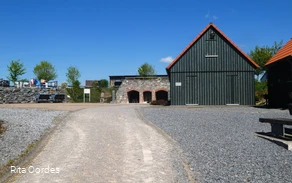
In addition, a Kalkofen modeled after a historical design and a corresponding informative exhibition on the topic of lime have been set up, where numerous exhibits, images, and explanations provide background knowledge on topics such as lime burning and lime mining in the past and present, the formation of massive limestone deposits, lime products, and the versatile uses of lime. The exhibition also features firsthand accounts that connect visitors to the local and regional history of lime.
The lime kiln itself was built as a ring kiln modeled after the historic Ehling-Weiken lime kiln. Lime was burned in the original Ehling-Weiken lime kiln from 1891 to 1954, primarily for use in agriculture. To start the firing process, a frame made of oak wood was first erected, and a fire was lit on top of it. Then, coal and limestone were alternately added. At temperatures exceeding 1,000°C, the limestone releases carbon dioxide. The finished lump lime was then removed through the lower openings, ground, and bagged for use in agriculture, for example as fertilizer. If, on the other hand, lump lime is added to a tub of water, it forms slaked lime, which is used to make lime mortar. After removal, the kiln was refilled from the top without allowing the embers to go out, ensuring continuous operation of the kiln.
At least once a year, the replica is lit, allowing visitors to experience the lime-making process up close.
It’s definitely worth a visit.